Introduction
Many industries and fields of study have concepts or ways of doing things that are taken for granted internally but are foreign or unknown to outsiders. Lawyers have legalese and engineers have jargon, but few fields have as large a barrier to understanding as electrical engineering. The phasor may be a staple of the electrical engineer, but being able to do phasor calculations does not mean that one understands the abstractions at play. Indeed, the concept of phasors is a difficult one to grapple with for seasoned engineers—let alone students. However, phasors are simply an excellent tool for analyzing AC power systems—a true gift from mathematics. Clearly understanding this tool and being comfortable applying it is worthwhile, and—with the right learning material—need not be a daunting task.
What is AC Power?
Alternating current, or AC, simply describes electric current that is oscillating. However, the term is also often used to describe oscillating voltage and electric power. This is perhaps more useful, as AC voltage is what drives an AC current, and the result—AC power—is what we use to do useful work. AC means that the voltage and current oscillates a fixed number of times per second, that is, at a constant frequency . In the vast majority of cases, this oscillation follows a sinusoidal wave.
Why do we use AC power? The key is in the name—alternating current is used in high-power applications, whether on the supply side or on the demand side.
On the supply side, we have the generation of electric power. Electric generators usually operate using rotating components. As a result, the most efficient types of generators—namely, synchronous generators—produce AC power, not DC power. Historically, when DC was favored, dynamos were used to generate DC power, but they are less efficient. Even now when DC power is needed, synchronous generators are used, and their output is efficiently converted to DC. Examples of synchronous generators include the alternator in your car (or your EV’s motor when used for regenerative braking), diesel generators such as those used by homeowners to power homes during power outages, and the generator in a power plant. These all produce AC power.
On the demand side, we have the consumption of electric power. The largest standalone electric loads are electric motors, the most efficient types of which consume AC power. For example, the electric motors in a diesel–electric ship or train, or in a large industrial plant, all consume AC power.
It is not necessarily enough that AC power is practical to generate and practical to use. In the case of the electrical grid, it must also be practical to transmit over long distances from where power is traditionally generated—large, centralized power plants—to the cities where it is consumed. However, transmitting power over long distances incurs power losses due to the resistance of transmission lines. Minimizing the power losses is achieved by transmitting power at high voltages. High voltages, however, are obviously unsafe and impractical for most consumers, so the voltage must be lowered as we go from transmission lines to distribution lines, into cities and neighborhoods. Furthermore, the voltage must typically be stepped up at its source—the power plant—prior to transmission. Transformers are the easiest and most efficient way to convert between voltage levels, but require AC instead of DC. So, in order to transmit power over long distances to where it is needed, while minimizing losses and delivering power at a safe and convenient voltage, AC power must be used.
Loads of All Kinds
An electric circuit is only useful if it accomplishes a task. In general, that task may be concerned with logic (as in a computer), signals (as in audio equipment or radio-frequency communications), or the transmission and conversion of energy (as in the electrical grid). Discussion will focus on the electrical grid, but also applies to “off-the-grid” applications such as diesel–electric vehicles. As the previous explanation of why we use AC power indicated, being able to transmit energy from one location to another is among the strengths of AC power. However, electrical energy is useless in itself unless it can be generated in the first place and can then go on to do something useful. A different form of energy must be converted to electrical energy (whether directly or indirectly) from an energy source. For example, nuclear, hydro, gas, and solar are sources of atomic, kinetic, chemical, and light energy, respectively. In most cases, the final conversion to electrical energy takes place in an electric generator. But the ability to generate electricity is useless unless electric loads are plugged-in and consuming power; without loads, the electrical grid would technically no longer be a circuit and would serve no purpose. Thus, the electrical grid, as a circuit, includes the loads plugged into it. The electrical energy that is generated is only useful if it can be converted, once again, into another form of energy. For example, a ceiling fan converts electrical energy to mechanical energy. Even a laptop computer—which when on battery power is just a huge, standalone logic circuit—generates heat as a necessary byproduct of its operation. When plugged in, from the grid’s perspective, a computer is little more than an electric heater.
Any load that can be plugged into the grid can be modeled by one of three simple discrete components—resistor, inductor, capacitor—or a combination thereof. For example, a laptop computer can be modeled by a resistor. A ceiling fan can be modeled by a combination of resistors and inductors. Furthermore, on the supply side, an alternator can be modeled by an AC voltage source, resistor, and inductor. Being able to model any load or generator in terms of just a few simple, standard electric components means that the methods used to analyze one AC circuit can be applied just as well to another.
A resistor dissipates electrical power. It typically does so by converting electrical energy to thermal energy, but in the case of loads such as a motor, most of it is converted to something other than heat (in this case, mechanical energy). Inductors and capacitors are also able to convert electrical energy. But, unlike resistors, that conversion is bidirectional; they can store their energy and convert it back to electrical energy. An inductor stores magnetic potential energy in a magnetic field, which can be used to temporarily sustain current, even when external voltage is removed. A capacitor stores electric potential energy (and thus electric potential, a voltage) in an electric field, which can be used to temporarily sustain voltage. This is shown in Figure 1.
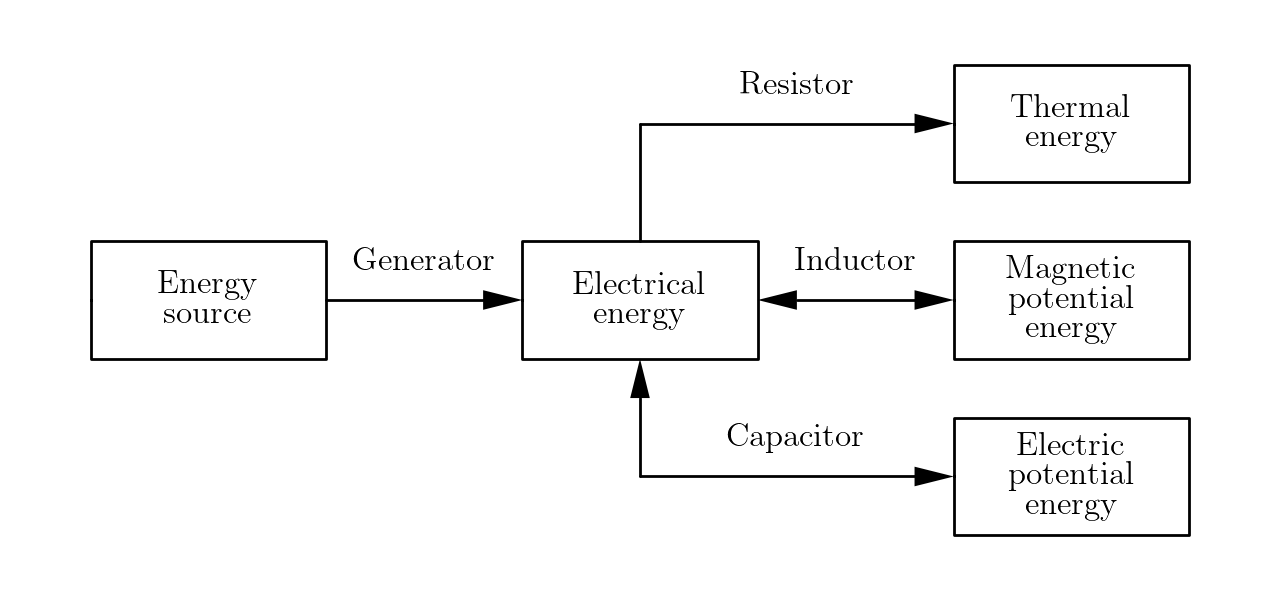
Figure 1:Conversion of energy by basic electric components.
DC Versus AC, Resistive Versus Reactive
Consider a circuit with a voltage source and a purely resistive load . If the voltage source is a DC source, of constant voltage , the circuit is DC. Current flows according to Ohm’s law, . As we will see in What is a Phasor?, if the voltage source is AC, its voltage can be expressed as . Ohm’s law still applies, and would now be written as . This means that as the voltage sinusoid reaches a peak, so does the current sinusoid —they are in phase. Figure 2 illustrates this. However, if we were to replace the resistor with an inductor or capacitor, the current would no longer be in phase with the voltage. A capacitor’s current lags behind the AC voltage, and an inductor’s leads it. As will be discussed in , this is closely related to the rate at which energy is converted in inductors and capacitors.
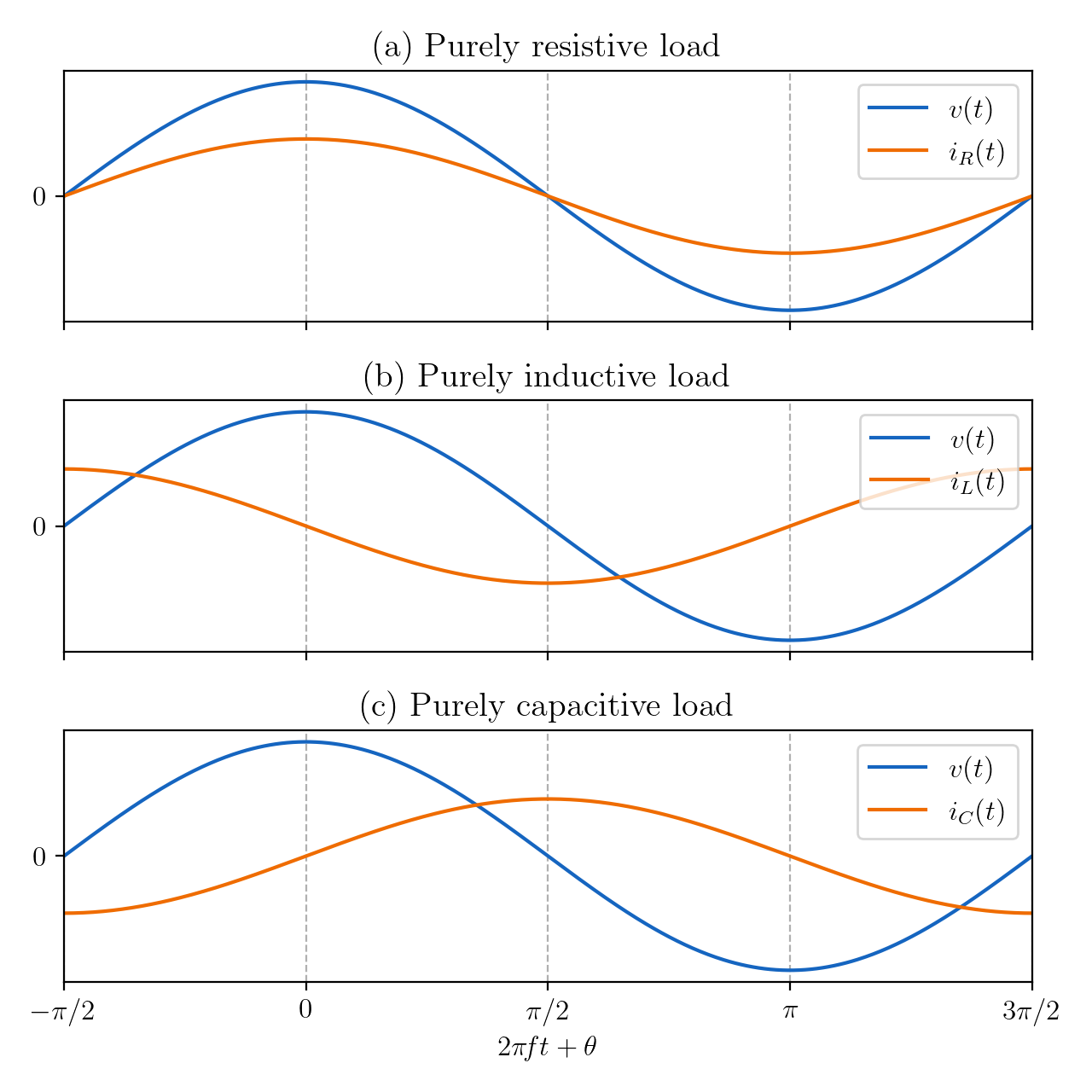
Figure 2:In-phase, leading, and lagging current waveforms in purely resistive, inductive, and capacitive loads.